
Anniversaries 2026
The Mohács Disaster of 1526 and the Parallel Dramas of 1956
This year two topics were chosen as the main themes of the daily compilations on the Facebook site. One of them the Battle of Mohács, which became one of the biggest disaster of the Hungarian history. (I would like to say thank you to Dr. Richárd Bottlik and his team, whose website I could use; about their new book you can read here) We left Istanbul with Suleiman I (1520-1566) on April 23, 1526 and followed him as he was approaching the Kingdom of Hungary and gathered his army. We also saw the problems on the Hungarian side, the lack of sufficient amount of money, the indecisive, young king, the magnates who were delaying to join the king and go to war. We got some taste of the lack of the support from Europe, or, we can say, the lack of the unambiguous support for the Kingdom of Hungary and King Louis II (1516-1526) to defeat the Ottomans. All of it shows the main points of the debates about the battle and its circumstances, and whether the dissolution of the Kingdom of Hungary was inevitable consequence of the defeat or it could have been avoided, or, probably, the signs were already visible before the battle.
Again, on one side, it is said, not everybody in the Kingdom of Hungary was interested in a successful campaign carried out by King Louis II. The sources contains rumours of treachery, defiance of the orders, time wasting, ignorance and discontent towards the king. Also, we can see the discontent of the Croatian magnates, who felt the king left them alone in their struggle against the Ottomans. We also know about the French-Ottoman connections, the conflicts Europe was engaged that time. On the other side, it is said, that the Hungarian magnates, prelates, nobles tried to do what they could, but the contemporary circumstances – which didn’t differ much from, for example, the ones of the period of King Matthias Corvinus (I. [Hunyadi] Mátyás, 1458-1490) – implied the possibility a defeat like this. Also, the European politics didn’t differ from what we saw before and after for centuries, and the Ottoman Empire was a mighty ally to backstab each other.
All in all, we could see, the Ottoman army reached the southern borderland of the Hungarian Kingdom faster – and they were besieging and capturing the border forts – than the army of the King of Hungary. It happened despite the heavy rains, floods, low-quality roads which made it harder to make such a big army move. On the other side, King Louis II marched at last to the South with an army, with the help – for example – of Pope Clement VII. We are a few days away now from the battle itself, which have been considered definitive for the Hungarian people in the last 500 years.

In connection with the other topic(s) we have two months left to reach the point when they – most probably coincidentally together – invoked the threat of a new, possibly nuclear, cataclysm. In Hungary we could see the effects of the de-Stalinization of Nikita Sergeyevich Khrushchev – see the 20th Congress of the Communist Party of the Soviet Union, February 14-25, 1956, and Khrushchev’s speech on February 25. There were public debates, even criticism of the leadership (see Petőfi Kör/Petőfi Circle), there were investigations and rehabilitations in connection with the politically influenced trials and unjust decisions in the previous years (see László Rajk). Imre Nagy, who fell out of favour the previous year, and his followers got more active, however, in the background, it was very important what Moscow said.
In the summer of 1956 the authorities backed down already in Poland (June 28-30, 1956), they violently suppressed the riots in Poznan, and soon stepped up before the process went to far. In Hungary, about the same time, Moscow’s decision was to replace Mátyás Rákosi as the First Secretary of the Hungarian Working People’s Party by Ernő Gerő. In Hungary Rákosi was the leader of the cult of personality, and the period was named after him. The change didn’t help too much, Gerő wasn’t less unpopular than Rákosi.
In this point we can find a person, who is an unexpected and absolutely coincidental link between the two dramatic series of the events of 1956, the President and Prime Minister of Yugoslavia, Josip Broz Tito. Some people said he was something similar to Moscow what Gamal Abdel Nasser was to the West. Tito was a target of verbal attacks of the propaganda of the countries of the Communist Bloc because of his ’renitent’ behaviour which caused confrontations with Moscow, and other countries of the bloc – including Hungary. For example, one of the charges against László Rajk was spying for Yugoslavia during his show trial. On the other hand, in 1956 Tito was urging Moscow to replace Rákosi.

At the same time, Tito had close ties with Gamal Abdel Nasser, President and Prime Minister – intermittently – of Egypt. Nasser put his comrade, General Mohamed Neguib (Naguib) aside first, with whom the led the Free Officers Movement to topple King Farouk (July 23-26, 1952), then he gradually became a leader of the Arab World, who was followed, copied or sometimes hated by his contemporaries, and also he showed an example for the liberation movements and the countries getting back their independence. (His death – September 28, 1970 – was a sign of a change in the Arab and Islamic World, the pan-Islamism got stronger compared to the pan-Arabism, which was connected to Nasser.) Another coincidence, that Nasser was a guest of Tito, together with the Indian Prime Minister Jawaharlal Nehru on Brioni/Brijuni Islands, and they signed the so called Brioni Declaration – which was an important step in the history of the Non-aligned Movement – on July 19, 1956, when the US Secretary of State John Foster Dulles decided to withdraw any American financial support from the Aswan Dam project. One week later, on Thursday, July 26, 1956 Nasser addressed to a crowd in Alexandria, and announced the nationalization of the Suez Canal which is considered as a starting point of the so called Suez Crisis.
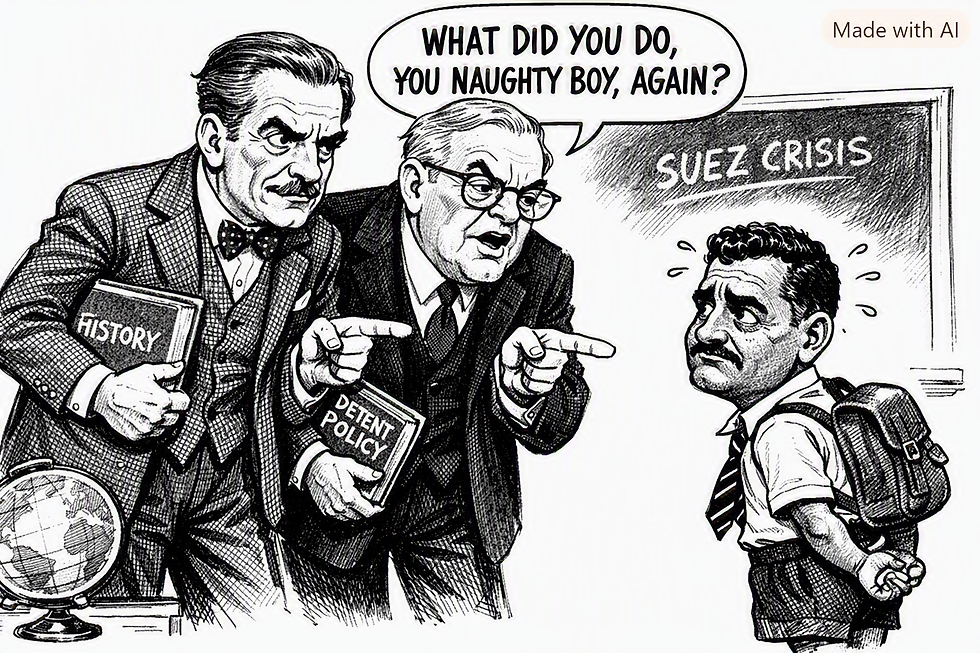
When General Neguib, Colonel Nasser and the Free Officers took over the power in Egypt, they weren’t ideologically attached to any of the big blocs. The former colonizer of the country was a western power and they could have some resentments because of the western support for Israel. Also, they have some leftist ideas and they planned a secular state, but it still wasn’t sure, which bloc they would join. In 1954 (October 19) they signed a new agreement about the Suez Canal with Britain, and the British troops left the Canal Zone on June 18, 1956. Only 12 years left until the Canal would have reverted to the Egyptian government anyway – even if Nasser allegedly criticized the Suez Canal Company not to maintain the Canal properly. However, Nasser, dissatisfied with the West, gradually orientated towards the Soviet Union which was obviously happy to gain ground in the former British sphere of influence. In September, 1955 Egypt made an arm deal through Czechoslovakia, buying Soviet armaments; some people was convinced that Nasser had a role in the dismissal of Glubb Pasha (Lieutenant-General John Bagot Glubb), the commander of the Jordanian Arab Legion in February/March, 1956; on May 30, 1956 Egypt recognized the People’s Republic of China, and established diplomatic relations with the country – Egypt was the first Arab country to do so. On the one hand, you can think that John Foster Dulles and the US wanted to warn and punish the renitent Nasser, and when it backfired the British and French reacted according to their old ‘colonizer reflexes’. On the other hand, there could be a narrative, saying Nasser was dissatisfied with the West, and tried to gain the trust of the Soviet Union, and took advantage on the situation and could show his defiance towards the West with his ‘revolutionary act’. And, of course, there could be different viewpoints between these two ones. At this point of the year, the 18 of the 22 participants accepted some proposals in the conference in London (August 16-23) – which was summoned a bit according to the old colonizer reflexes as well – and the Australian Prime Minister Robert Menzies and an international committee would take it to Nasser soon.
I hope I can have the privilege to continue to follow these events together with you...
(The pictures were made by AI)


Comments